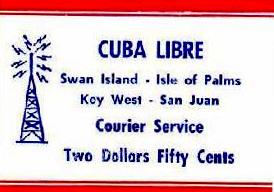
Brief History of Radio
Swan
[From
Taylor report]
ANNEX 2
EYES ONLY SECRET
Brief History of
Radio Swan
1. On 17 March 1960, President Eisenhower approved a covert
action
program to bring about the replacement of the Castro
regime.
Within the propaganda framework of that program, an
important objective
was to create and utilize a high-powered medium and short
wave radio
station. CIA was asked to provide such a station, outside
the
continental limits of the United States, and have it ready
for
operation within sixty (60) days.
2. Swan Island, in the Caribbean, was chosen as an
appropriate site.
The United States Navy furnished CIA with splended support:
within
sixty days, equipment had been brought from [intentional
blank], a
landing strip was cleared on the island, and the station was
able to go
on air on 17 May of the same year, precisely on schedule.
3. Originally it was planned that Radio Swan would be a
clandestine
station [intentional blank]. Just prior to inauguration,
however, it
was decided the station should be a commercial one. This was
at the
request of the Navy, which reasonably argued that should
their
participation in construction of a black facility be known,
explanations would be difficult.
4. Using a "commercial" station for the tactical and
strategic tasks
envisaged for Radio Swan is not, of course, the most
desirable way to
support a covert operation. The only pracitical method of
operation is
to "sell space". Thus, program time on Radio Swan was gold
to various
Cuban groups. These included organizations of workers,
students, women,
two publications in exile, two radio stations in exile, and
several
political groups. [intentional blank] Programs (on tape)
were produced
in [intentional blank] and later, on Swan Island.
5. Radio Swan effectively reached not only its target area
of Cuba, but
the entire Caribbean as well. Soon after broadcasts began
Castro
started jamming, but was sucessful in hindering reception
only in the
City of Havana. Scores of letters were received from all
parts of Cuba
to show that the station had listeners. As late as March
1961, a survey
was made to determine the extent of listening coverage. An
inexpensive
ballpoint pen was offered to those listeners who would write
in to the
station. The reply was immediate: almost 3,000 letters from
26
countries. This barrage of mail included significant amounts
from all
parts of Cuba.
6. As Radio Swan progressed, it became the symbol of the
anti-Castro
effort within Cuba and of opposition to Castro throughout
the
hemisphere. Toward the end of 1960, the effectiveness of
Radio Swan
began to diminish. Although great numbers of Cubans still
listened to
the station, its credibility and reputation began to suffer
as the
result of statements representing the selfish interests of
the Cuban
groups producing the various programs. In the first place,
these groups
talked overmuch about their activities in Miami and the hard
fight they
were conducting along Biscayne Boulevard. Naturally, the
Cubans who
were suffering under the Castro dictatorship within Cuba
resented this.
Secondly, the Cuban programs became a fulcrum where
individual
political ambitions of Cuban exiles in Miami were presented
to the
other Cubans in Miami, forgetting the all-important target
audience
within Cuba. Finally, each program fought with the other for
"scoops".
As time passed and the Cubans found that their sources of
information
were no better than the next fellow's, the program producers
began to
exaggerate in order to give their broadcasts a touch of
sensationalism.
They made statements which were obvious lies to listeners.
An example:
One of their announcers stated that there were 3,000
Russians in a park
in Santiago de Cuba -- the residents had only to walk to the
park to
see that this was untrue. Moreover, the various programs
began to defy
coordination. All programs but one told the Cuban militiaman
that he
would be a hero on the day that he defected from Castro. The
sole
exception told the Cuban militiaman that he would be hanged
regardless
of what he did. [intentional blank] This action failed to
achieve
proper control.
7. As this unfortunate situation developed, the military
operation was
about to be launched. It was obvious that CIA could not
allow
uncoordinated programming to continue while the station
attempted to
provide tactical support to military forces. On the 27th of
March 1961
each program producer received a letter from the management
of Radio
Swan informing him of the termination of his program.
Broadcasting was
not suspended. Rather, it was immediately replaced with a
new, overall
programming schedule--more broadcasting hours than before
[intentional
blank] Thus Radio Swan was converted into a station which
provided the
Cuban people with straight news as well as a program which
stated its
only function was to assist those who were fighting Castro
within Cuba.
This was the beginning of an intensified propaganda campaign
directed
against Castro. Within a few days after the change, Radio
Mambi, a
Cuban government station, said to its listeners, "the
hysterical
parrots of Radio Swan have recently raised their voices
scandalously."
On the day following these declarations by Radio Mambi,
President
Osvaldo Dorticos declared in a speech over another radio
station,
"Cubans must be alert for lies and attempts to destroy the
revolution
through psychological warfare." A Cuban newspaper, at the
same time,
repeated Dorticos' statement: "Our enemies are intensifying
psychological warfare to find weak points in our domestic
front."
8. During the military action in Cuba, Radio Swan was used
in tactical
support of the strike force [intentional blank] Radio Swan
was
monitored by hemisphere radio stations and by world news
services, and
was an important factor in presenting the desired picture of
the
fighting in Cuba to world opinion. Despite some press
allegations,
Radio Swan was not responsible for the wild rumors during
those hectic
days. [intentional blank]
9. When it became obvious that the main attack on Cuba had
been
unsuccessful, Radio Swan deliberately anticipated Castro's
victory
[illegible] by admitting that the Cuban Expeditionary Force
had been
stopped by Communist armament, but that many of the Freedom
fighters
had been able to join resistence groups in the hills. Radio
Swan then
returned to a calm presentation of world news and over a
period of one
week changed from round-the-clock broadcasting to a normal
schedule,
avoiding all program content designed to incite the Cuban
people. The
producer of the consolidated program was instructed to
present programs
with a minimum of [illegible] content, but to continue the
anti-Castro
orientation through the selection of news items. At the
present time
present time, Radio Swan is broadcasting simultaneously over
medium and
short wave daily from 0500 to 0600, from 1230 to 1400, and
from 1800 to
0015 (E.S.T.). The broadcasts are made up of hourly
news,
[intentional blank] and other commercial programs including
the relay
of [intentional blank] Neither during nor after the
strike phase
has there been any [illegible] of Radio Swan from any
country other
than Cuba and the United States.
End of Page
Copyright
1998-2014 Cuban Information Archives. All Rights
Reserved.