CUBAN RELIGIOUS BELIEFS
OF AFRICAN ORIGIN
[GENTE
Magazine, Vol. 1, Havana, January 5, 1958, No. 1, American
Edition]
Page35
PHOTO CAPTION
- One
of Cuba's strongest African customs is that of visiting
the famed ceiba
tree at the Template on Saint Christopher's day.
This African
Custom is complied with by Havana residents on the
appointed date of
every year.
RELIGIOUS BELIEFS OF
AFRICAN ORIGIN
It is impossible to find in Cuba even a small segment of
art, custom
and tradition which does not contain a vestige of
Africa. The
integration of the country has been in progress for
centuries; the
contributions of the two races have been equally
vigorous. On the
one hand the Spanish blood, mixed with that of the Arabs and
the Moors;
on the other the African blood of former Negro slaves.
The
mixture of the two blood strains is evident in all
Cubans. The
following report will attempt to show as exactly as possible
the type
of culture in formation in Cuba today under the influences
of modern
civilization which play a large role in the nation's
development.
Suffice it to say that the religious customs and beliefs of
the
Afro-Cubans as practiced on the island today contain no
remnants of
cannibalism or witchcraft. The only "human sacrifice"
entailed is
the payment of "fees" as demanded by the Babalao. The
rites,
therefore, are as highly respected as any other religious
belief which
has developed over the centuries in peace and harmony with
the
Christian moral.
The photographs used to illustrate this report are forbidden
by the
laws of Santeria. GENTE has gone to great lengths
information and
entertainment.
VOCABULARY
Santería - The religious belief of the Negro Lucumis or
Yorubas
after their arrival in Cuba and other islands of the
Antilles group.
Changó - The god of war of the Lucumi belief, identified
with the Catholic's Saint Barbara; his color is red.
Ochosí - The god of the hunt, also representing justice.
Elegguá - The god of the highways. Elegguá is really
three gods in one– Echú, Laroyé and Elegguá.
Ochá - The name given to the African belief which preaches
goodness, or Santería.
Babalú - Ayé - A warrior god and a leper, who was
expelled from the land of the Yorubas and later reigned in
Congo
land. He is the brother of Changó and is identified
with
the Catholics' Saint Lazarus.
Yemayá - Goddess of the seas, owner and creator of the
world. Her color is blue. She was Changó's first
lover and in turn was his adopted mother.
Ebbó - The name for a practice in Santería whereby evil
influences are cast out of the worshipper's body and spirit.
Güije - A type of gnome who dwells under bridges in the
rivers. He is a mischievous and diabolic spirit.
A poe
describes Güijes as "dwarfs with enormous navels' and speaks
of
"their short and twisted legs their large straight
ears". The
Güije has the power of changing shapes and being ubiquitous.
Oggún - The god of iron, owner of arms and machinery.
A warrior, his color purple.
Babalao - The supreme priest of Santería. His name
means wise man. He is a protege of Orula.
Page 36
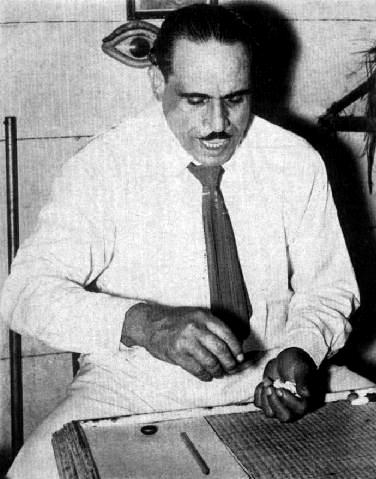
PHOTO CAPTION
- The
Santero put his question to the Snails of the Diloggun,
the scared book
which contains the answers to any question put to it by a
worshipper. The position of the snails when they
fall into place
provides the Santero with his answer.
Orula - The wizard owner of the divination board and
necklace.
Bembé - The great feast of Santería (described in text)
Ifá - The necklace used by Babalao for his divinations.
Ekuele - The divining board on which Babalao throws the
necklace of
Ifá, the position of the necklace indicating the answers to
questions put to it by the worshipers.
Aleph - God, the supreme creator.
Ilé - Home, domicile, residence.
Obatalá - Goddess of purity and representative of
Olofi.
She is "owner of all the heads" and the only one able to
communicate
directly with Olofi when he comes down "the road of Osán
Guiriñán". Obatalá is the equivalent of Our
Lady of Mercy.
Osán Guiriñán - A road known only to
Obatalá and leading to the "ilé" of Olofi atop an
inaccessible mountain.
Oyá - Goddess of cemeteries, identified with the Catholics'
Candelaria.
Aché - The gift and power granted by Aleph.
Agallú - Solá - The boatman appointed by Aleph, identified
with Saint Christopher.
Icú - Death, works for "Oyá" who presides over the
cemeteries.
Gangulero - A priest who practices evil, a witch.
Amalá - A food of cornflower and mutton and preferred by
Changó.
Iyalochá - Priest, or initiated woman, minor official of the
Lucumí religion.
Apesteví - The priest's helper, a kind of waitress who cares
for
the "prendas" or saints. Pure and chaste at the
outset, she later
becomes the concubine of the priest whom she assists.
Jícara - A typical Cuban cup made of a half-empty
güira. The güira is used in making "maracas".
Batas - Sacred drums used in the festivities. Their
name are Okonkoló, Iyá and Bata.
Since 1515, when the firs cargo of African slaves arrived in
Cuba, the
religious customs of the Negroes have played a large part in
the
beliefs or the Cuban people. The fusing of the
Christian ritual
of the Spaniards' and the pagan ritual of the primitive
people has
resulted in a true religious sincretism. Today the
mixture of
African fetishism and the refinements of Western religious
forms the
bread basis for a large segment of the Cuban people.
It is not strange, therefore, to meet an elegantly dressed
woman with
aristocratic bearing on t he streets of Havana and note
somewhere on
her person evidences of primitive beliefs known throughout
Cuba as
"santeria". You may see among her gold jewelry and
adornments
–pure gold pins and decorations are not uncommon in Cuba
today– a
golden sword, a bow and arrow or a bracelet of knitted
leather with a
core of gold or coral. You may notice that she is
wearing seven
bracelets, or that she has a small chain on her ankle. All
are symbols
of beliey [belief] in some African god...
The "Sons of Changó" exhibit their war sword on their chests
and
their lapels. The "Sons of Ochosí" display the bow an
arrow. Bracelets are the symbol of Ochún the Venus of
those of the Lucumí sect.
If you visit a Cuban home you may not see any inmmediate
[immediate]
indications of santeria beliefs. But perhaps you will
later note
a small cabinet behind the door. This is the "home" of
Elegguá, in African credo the custodian of roads and
highways
and who, according to the laws of Ochoa, is trusted with the
safety of
the home. Behind the door you may also find the
"bread" of
Babalú Ayé. You may also notice a duck which is
permitted complete freedom in the house. Or you may
notice that
the dog of the house is treated as
Page 37
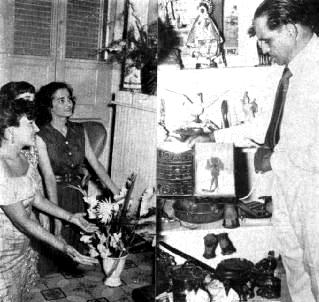
PHOTO
CAPTION - Santero
Felipe
Montes de Oca demonstrates a devil fish while in the
background
can be seen the "canastillero" where the saints
live. On top of
the "canastillero" are visible the African "Orishas", or
symbols of
Catholic saints, mainly the "Caridad del Cobre", showing
the mixture of
African and Catholic religious figures.
ADVERTISEMENT
- Hotel Copacabana
though he were the owner instead, and all because it is so
decreed by Babalú.
Sometimes, at high noon as you walk through the neighborhood
streets,
you will see someone throw a bucket of water out on the
sidewalk, or a
woman will intentionally drop a bottle of clear, clean water
in the
middle of the streets...
And then at dawn some day you will find the "refuse of Ebbó"
or
at street corners. It was left there by believers to
drive away
the evil spirits...And if you pass under two crossed palm
leaves, you
may find on the ground nearby apples, bananas and red
handkerchiefs
–all dear to the warrior Changó de Imá...
And in the country there are still Cubans who will not
whistle inside
empty houses because it serves to summon the "güijes".
And
there are also those who, before stitching a piece of
clothing worn by
another person, will prick the wearer slightly to prevent
the god
Ogún from forcing a slip of the needle. And there are
still people who prick their fingers with a new
Page 38
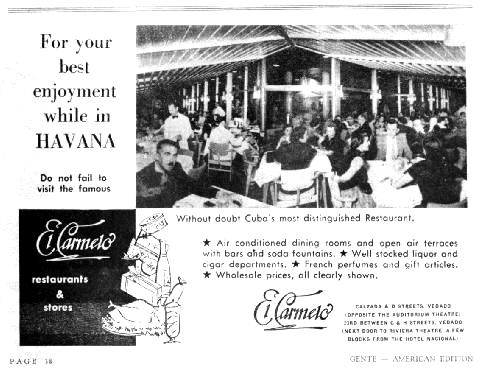
ADVERTISEMENT
- El Carmelo Restaurants and Stores
knife before using it for the first time.
Until very recently believers in these truely [truly]
African customs
offered a "bembé" to Ogún in the sugar mill before
starting the refining process. And a dark-colored dog
was placed
on the railroad tracks to appease the god who presides over
iron,
machinery and armaments and thus prevent serious accidents
during the
milling.
All of these practices are "trabajos" and are santeria
ritual.
They are explained by the racial integration of Cuba where
Negro
traditions and beliefs, brought from Africa, has fused with
those of
the Spanish "conquistadores".
Cuba today is full of santeria beliefs as well as persons
who,
unknowingly perhaps, still carry on traditions passed on
from their
grandfathers and which had their origins in the jungles and
flat lands
of Africa.
The true believer who visits the "babalao" places his faith
and hope in
the rites conducted by the pagan priest. The latter
recites and
esoteric dialogue between the gods while the necklace of Ifá
is
thrown on he Ekuele board by an unseen hand. The
believer knows
that the "registro" or advice which he receives from babalao
is the
true word of God, for babalao, which means "wise man", knows
all.
Babalao is the representative of Orula, the god to whom
Aleph, the
Supreme Creator, entrusted the divining board when it was
abandoned by
undisciplined Changó.
And because its law is the law of God, the believer does not
hesitate
to heed and obey its commands, regardless of the effort or
consequences
it may entail.
HUMAN ASPECTS OF THE GODS
One must understand that primitive peoples select their gods
from among
their better known neighbors. Legend tells us, for
instance, that
Aleph, weary of ruling the world with its endless problems,
decided to
divide his powers among the saints of the Lucumí pantheon
and
retire to an isolated and inaccessible hilltop, to the top
of which
only Obatalá and the mischievous Eleguá knew the route.
So Aleph gathered around him the saints and explained his
decision. He called forth Yemayá and placed all the
seas
in her lap. Then Saramagua shook her skirt and
separated the
oceans and the continents, giving the world the
configuration that is
has today. To Changó, Olifí gave the lightning, the
thunder and the thunderbolts; to Ochún he gave the rivers
and
the honey and the waters of the sweetest springs; to Ogún he
gave the iron; to Elegguá he gave the roads and highways;
and to
Oyá he gave the cemeteries. And so it went.
Each of the gods thus sanctified retained his particular
characteristics.
Page 39
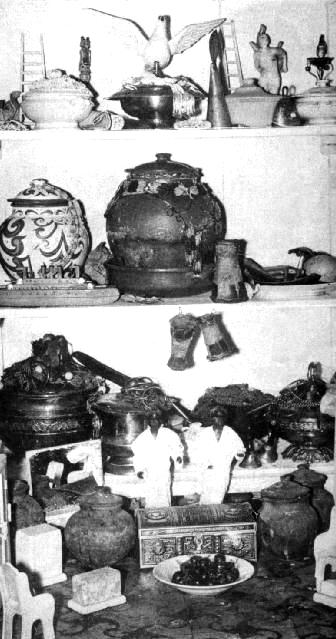
PHOTO CAPTION
- The
Santero officiates before the "canastillero" in which the
African gods
dwell. Here the practices of Santeria are
conducted. This
is the room of the saints. Seen on top are Obatalá,
Ochosí and Ochún. In the center are Yemayá
and Changó, and underneath Ogún and Oyá. On
the floor are the Obeyes or twins.
Ochún continued to be lascivious; Yemayá, maternal;
Obatalá, austere and pure; Changó, mischievous, fickle,
voluble and astute; Ochosí; Agallu Sola, rigid and severe.
Thus the African saints retained all the humans traits, both
good and
bad. And that is why they love, hate, envy, argue,
fight and,
despite the fact that they are gods, that they are
occasionally
deceived by those who believe in them.
"CHANGING THE HEAD"
When a persons is seriously ill and Icú, the god of death,
demands their life, the santero or priest of voodoo is
permitted to
"change the head".
This ritual consists of offering up prayers in the wizard's
room in
which the priest officiates at his mystic ceremonies.
The prayers
result in the transfer of the illness from the sick person
to another
person, be he healthy or sick. And if this other
person
does not, in the same manner, have the sickness transferred
to still
another person, he will surely die.
The wizard explains the ritual thusly, that Icú demands a
dead
body and that his desire must be granted; and that as it is
immaterial
what body be given up to the god of death, the body of
another will
serve the purpose as well.
And this is the ritual which is called "changing the
head".
Crying for the Sic Person
Unfortunately there are times when it is next to impossible
to convince
Icú that another body will serve as a worthy substitute for
that
of the sick man over whom the priest is praying.
Then the work cut out for the priest is more
difficult. He must apply stronger and more dramatic
measures. So a
Page 40
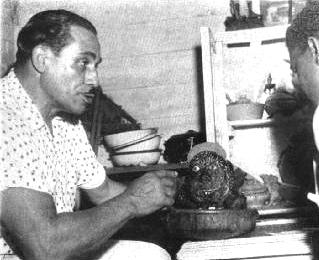
PHOTO CAPTION
- A head of
roughly-carved stone of singular primitive beauty
represents the god
Elegguá dwells in the pan of clay in which are embedded
the 21
snails which represent "the roads" of the god. It
is identified
with the Catholics' Baptist. In many Cubans houses
Elegguá
is found behind the door for protection of the home.
close relative of the patient, usually his mother or his
wife, will
dress a puppet made by the wizard in some of the sick man's
clothes. The puppet will then be taken to a cemetery
at midnight
and buried. Then the mourner will weep by the tomb so
disconsolately that Icú will be convinced that the sick man
has
in fact died.
Sometimes these extreme measures are not necessary.
Powdered egg
shell or some coloring may be applied to the sick's man face
and will
so disguise him that Icú will believe him already had
died...
The same practice is also used to deceives enemies when they
try to inflict serious injury on a person.
THE FOOD OF THE SAINTS
Before the altars of their gods, believers place their
deities'
favorite dishes. For Ochún there are fried green
bananas;
to Obatalá they serve popped corn; for Changó there is
"Amala" and bananas, while tobacco and brandy are served to
the
demanding warrior gods...
Sumptuous banquets are served, however, on the occasion of
large-scale
celebration in honor of the gods, Babalao officiates at
these feasts,
assisted by Iyalocha, the Apestevi and their "godchildren".
Animals are slaughtered for the feast in large quantities
and in each
case the rigid laws of the beliefs are scrupulously
observed.
Babalao is the only god to whom four-legged animals can be
sacrificed,
for example. Bipeds may be sacrificed to the Santera,
or
Iyalocha. But each rite demands the attedance
[attendance] of the
worshipper who is preparing the feast. All sacrifices
must be
made in his presence. Each piece of the quartered
animal is
placed in front of him after he has been touched on the
head, palms,
knees and ankles with the dead flesh.
While this is being done the worshipper invokes the gods and
makes the offering in the Lucumí tongue.
The blood of the animals is collected in "jícaras" or in
porcelain cups, mean while, and is offered later to such
gods as
Oggún, who usually demands it.
THE BEMBÉ
The main ceremony of Santeria is the Bembé or "toque de
Santos"
as it is also known. The rite both begins and ends
with prays to
Elegguá
The ceremony resounds to the sound of the "atabales".
The "batas"
drums beat incessantly. The "güiros" provide further
background for the choir of voices which raises its chant to
the
dwelling place of the "orishas". The faces of the
worshipers seem
transformed by the esoteric summons to possession. The
gong of
the atabales sounds louder. The odor of the jungle
invades the
place of worship. The chant grows louder on the Lucumí
tongue:
"Ilá mi ilé oro...
"Ilá mi ilé oro...
"Iyá mi.
"Iyá mi, Saramawooooo
"Iyá mi ilé oro...
The sweating bodies shake in a frenzy with each beat of the
drums. Legs, shoulders and bodies tremble as if
reacting to an
electric shock. A strange feeling of well-being
invades every
heart; it is visible in he emotion-twisted faces and the
bleary eyes of
the dancers. Their temples pound. At last
–a body
becomes possessed. A woman falls to the floor, her
body jumping
savagely, while from hundreds of throats the cry resounds.
"Gecua, Gey..."
This signifies the arrival of the saint. He has
entered the body
of a believer. He is among them and preparing to speak
with the
tongue of his "horse" and to dance in the physical form of
his
"instrument".
If you were to ask the santero what happening, he would tell
you that
Page 41
ADVERTISEMENT
- Gran Hotel de Santa Clara
the saint has displaced the soul of the worshipper and
occupied his
body, to be able to communicate with men here on
earth. The
saint, he would tell you, is of spirit and space and lacks
the physical
attributes of a human...
Now the saint dances frenetically to the beat of the drums
which incite him to further frenzied motion.
The Bembé has entered its moments of climax. Now
everything is jungle –primitive, vigorous, fringed with
omens and deep
fears...
Before "departing", the god will speak to the men, will
advise hem on
ways to preserve their health, to avoid "troubles", to help
others find
employment. The god will also ask his due; he will
demand a feat;
he will even threaten his naughty "children".
And when the saint has left the body of the "aleyo", faith
and belief
will be stronger, and the body of the possessed will be sore
in the
aftermath of its frenzied contortions.
These are the origins of the diverse African belief still
found in
Cuba. They are everywhere on the island. A
traces of
Africanism remains in every Cuban, giving rise to a popular
tune which
goes:
"He who does not wear yellow (the color of Ochún).
"Covers himself with blue cloth (the color of Yemayá).
"Or red (belonging to Changó)".
That is also the thought behind the proverb: "There are
those who remember Saint Barbara when it thunders".
For the same reason a politician once noted that "in Cuba
the man who
does not have an ancestor from the Congo has one from
Carabalí..."
Article by columnist:
FELIPE ELOSEGUI
End of Page
Copyright
1998-2014 Cuban Information Archives. All Rights
Reserved.