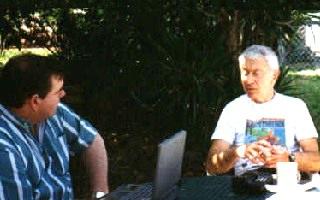
Gaeton
Fonzi
Interview
26 April 1996 with Steve Bochan
[Interview focuses on the
Silvia Odio
incident]
[BEGIN]
The following conversation with Gaeton Fonzi took place in
Fonzi's home
in
Miami, Florida on 4/26/96. Present were Gaeton Fonzi,
G Winslow
and
Steve Bochan. Speakers are designated as follows: GF =
Gaeton
Fonzi;
GW = G Winslow; SB = Steve Bochan, and some editing took
place to
clarify
and/or eliminate repetition.
No questions or answers were discussed ahead of time and the
interview
took
place as a casual conversation.
************************************************************************
SB: Out of curiosity, and for the benefit of the people who
haven't
read
your book, THE LAST INVESTIGATION, can you describe how you
became
interested,
before the HSCA investigation, in the JFK assassination?
GF: Yes, I wrote about it in the book. I was working for
Philadelphia
Magazine
at the time and Arlen Specter happened to be a
Philadelphian.
Vince
Salandria was a local lawyer who wrote an article in The
Legal
Intelligencer
about the Warren Commission Report, specifically about the
shots and
trajectories
and the head hit, which was the area in which Arlen Specter
work. I
remember
thinking that Salandria has to be some crackpot, telling
everybody that
the
Warren Commission Report might be wrong. So I decided
to an
article
for Philadelphia Magazine about this crackpot lawyer who
said the
Warren
Commission might be wrong. And that's how I got
involved.
After
I interviewed Salandria and studied the Warren Commission
Report I
became
convinced that Salandria wasn't a crackpot and, then, after
interviewing
and questioning Arlen Specter, I also became convinced that
the Warren
Commission
Report was in fact, not the truth.
SB: What was it, in particular about Arlen Specter, that you
...
GF: His inability to explain the single bullet theory.
SB: I think he admitted to you, you mention it in the book I
think,
that
there were some problems with it, or words to that effect,
didn't he?
GF: They had some problems with explaining how come there
was a hole in
the
back of his jacket and shirt, about 6 inches down from the
collar...
[On page 27 of THE LAST INVESTIGATION, Fonzi's encounter
with Arlen
Specter
is described as follows:]
The photographs of the shirt worn by the President shows a
hole in the
back
consistent with the one in the jacket, about
five-and-three-quarter
inches
below the top of the collar and one-and-one-eighth inches to
the right
of
the middle. The discrepancy is obvious.
The locations of both these holes are inconsistent with the
wound below
the
back of the right ear described in the Commission's autopsy
report.
I'll never forget asking Specter about that as I sat in his
City Hall
office
in Philadelphia. (It was about a year after he had returned
from his
Warren
Commission job; he had recently been elected District
Attorney.)
"Well," he said, "that difference is accounted for because
the
President
is waving his arm." He got up from his desk and
attempted to
demonstrate
his explanation on me, pulling my arm up high over my
head. "Wave
your
arm a few times," he said, "wave at the crowd." He was
standing
behind
me now, jabbing a finger into the base of my neck.
"Well, see, if
the
bullet goes in here, the jacket gets hunched up. If
you take this
point
right here and then you strip the coat down, it comes out at
a lower
point."
A lower point?
"Well, not too much lower on your example, but the jacket
rides up."
If the jacket were "hunched up," I asked, wouldn't there
have been two
holes
as a result of the doubling over of the cloth?
"No, not necessarily. It ... it wouldn't be doubled
over.
When
you sit in the car it could be doubled over at most any
point, but the
probabilities
are that ... aaah ... that it gets ... that ... aaah ...
this ... this
is
about the way the jacket rides up. You sit back ...
sit back now
...
all right now ... if ... usually, as your jacket lies there,
the
doubling
is right up here, but if ... but if you have a bullet hit
you right
about
here, which is where I had it, where your jacket sits ...
it's not ...
it
ordinarily doesn't crease that far back."
What about the shirt?
"Same thing."
Was Specter saying there was no inconsistency between the
Commission's
location
of the wound and the holes in the clothing?
"No, not at all. That gave us a lot of concern.
First time
we
lined up the shirt ... after all, we lined up the shirt ...
and the
hole
in the shirt is right about, right about the knot of the
tie, came
right
about here in the slit in the front ... "
But where did it go in the back?
"Well, the back hole, when the shirt is laid down, comes ...
aah ...
well,
I forget exactly where it came, but it certainly wasn't
higher, enough
higher
to ... aah ... understand the ... aah ... the angle of
decline which
..."
Was it lower? Was it lower than the slit in the front?
"Well, I think that ... that if you took the shirt without
allowing for
its
being pulled up, that it would either have been in line or
somewhat
lower."
Somewhat LOWER?
"Perhaps. I ... I don't want to say because I don't
really
remember.
I got to take a look at that shirt."
SB: Supposedly that was the so-called "hunched up" jacket
and "hunched
up"
shirt theory ...
GF: Yeah, so that's what got me interested, really.
I did a few articles for Philadelphia Magazine on the
Kennedy
assassination.
The first one of course was on Arlen Specter.
And then when I moved down here, a friend of mine - a
reporter -
had stopped in to see a friend of his who was Schweiker's
administrative
assistant. Schweiker was on the Church Committee at
the time and
had
convinced Church to set up a subcommittee on the Kennedy
assassination,
which
Schweiker headed. (Gary Hart was co-chairman but he
didn't take
much
interest in it.) And my friend and Schweiker's
assistant started
talking
about Schweiker's interest in the Kennedy assassination and
the fact
that
he was getting more interested in the relationship between
the CIA and
the
anti-Castro Cubans, while the Church Committee investigators
were
concentrating
on the pro-Castro angle.
Being that Schweiker's anti-Castro interest effort was
focused on
Miami,
my friend Greg said, "Well, Gaeton's in Miami," and as a
result of that
I
got a call from Schweiker's man, Dave Newhall, a former
Philadelphia
reporter
whom I had known. Newhall called me said he had a few
things to
check
out in the Miami area and would I have the time to check
them out.
I said, "Sure, how long will it take?" and he said, "just a
couple of
weeks."
(laughter)
SB: A couple of weeks?
GF: A couple of weeks turned into three years.
SB: One of the devices you use to both open and close the
book which
was
very powerful, I thought, and probably very powerful for
those of us
who
have been to Dealey Plaza, was your description of your
emotions when
you
went there. You stood in the middle of Elm Street and
became
overwhelmed
with what happened there and, you wrote, "Right here ... is
where a man
died.
... A man's life ended."
That's very dramatic and anyone who has been to Dealey Plaza
knows that
feeling
and I thought it was both moving and effective to begin and
end the
book
that way.
Is that also what finally made you determined to go into
this, after
you
went there and stood in the middle of Elm Street,
contemplating the
gravity
of that crime?
GF: Well, no. I wrote that in the context of having
worked with
the
Committee. I went to Dealey Plaza back in the '60s
when I first
did
the article for Philadelphia Magazine, and I really didn't
have a full
grasp
of the whole Kennedy assassination at that point. But
it was
still
a very moving thing to see.
But what really got to me is when I got there, and after
having worked
with
the Committee, having been in Washington, and having been
involved in
so
much of this bureaucratic charade, as it were, and then
coming to
Dealey
Plaza and it made me think, 'My God what are we doing?
What have
they
been doing in Washington playing with all these documents
and
everything?'
And here they were getting ready to turn out a report that
was going to
tell
the American people that we did a thorough and complete
investigation
and
I knew that wasn't the case.
It just made me realize that they forgot the basic point
here that a
man
was killed. A man was killed ...
SB: Some of your critics on the Internet and on CompuServe
are very
quick
to point out that you came into the investigation already
determined to
prove
a conspiracy. In other words, they'll say, 'Well you know,
Gaeton Fonzi
wasn't
really an objective investigator - he had already made up
his mind that
there
was a conspiracy,' etc. A counter argument, of course,
is that
Blakey
himself was already determined to bring the Mafia into the
assassination,
and of course, Earl Warren was determined to blame it all on
Lee Harvey
Oswald.
How would you react to that criticism that you had already
made up your
mind
with regard to there being a conspiracy in the JFK
assassination?
GF: It's true. I had already made up my mind years ago
as a
result
of the investigation and as a result of the work I had
already done on
the
Kennedy assassination. Especially as a result of the
interviews
with
Arlen Specter; that the single bullet theory didn't hold
water.
And
once that conclusion is reached, there is a conspiracy.
But, as an investigator involving areas that really had
nothing to do
with
whether or not there was a conspiracy - because we certainly
wouldn't
have
been conducting the investigation on the basis (like the
Warren
Commission
did) that Oswald alone did it. But as long as you don't
angle your
approach
or deliberately attempt to manipulate your questioning or
narrow your
perspective,
it's really is irrelevant when you are interviewing people
and when
you're
digging up information.
The other point is that I had nothing to do with controlling
the
direction
of the investigation: I mean that was Blakey's job.
And even at
that
point, I don't think the question of conspiracy or
non-conspiracy is
relevant
here. If we were going to accept the Warren Commission
Report as
the
final word, there would have been no need for an
investigation.
SB: Do you keep in contact with Blakey; do you talk to him
ever?
GF: (laughter) No, I haven't talked to ah, Bob Blakey
...
SB: Did you part on good terms?
GF: Yeah, basically I like the guy. You know, we just
have a
difference
of opinion I guess, when it comes to whether or not the
investigation
was
a full and complete investigation as the report claims it
was.
I don't have any personal animosity towards Blakey or
anything.
SB: Getting into Silvia Odio, in the book, you relate how
disappointed
you
were that they didn't ask her to testify, but, who's
ultimate decision
was
that - was that Blakey who decided that the time was running
out, the
budget
was running out, etc.? It almost sounded like the
Warren
Commission's
Rankin saying that they were supposed to be closing doors,
not opening
them...
GF: Yeah, it was Blakey's decision to spend the time in the
public
hearings
on organized crime. Now he will say, 'but, we put
everything on
the
record,' and that's true. But the impact that would
have had on
the
American public, I think, would have been tremendous.
And it was
his
decision to limit the public hearings to those areas that he
wanted to
cover.
SB: How did Silvia Odio react to that? I remember you
described
her
gaining trust and confidence in you, the time that that took
to do
that,
and so forth, and then when she was finally ready ...
GF: Oh, yeah, she was terribly disillusioned, and
bitter. I mean,
because
she really had to psyche herself up into coming
forward. Jim
McDonald
and I spent a long afternoon convincing her that this is
what she
really
should do; that the American people should know her story
directly from
her
for the first time. And on the basis of her trusting
us, she
said,
'okay, I'll do it,' but she really didn't want to do it; she
was a very
emotional
person to begin with; she had arranged to take off work and
her husband
arranged
to take off work because she needed his support; and then
all of a
sudden
the rug is pulled out from under her. She was terribly
disillusioned.
SB: Were you the one who had to tell her that it wasn't
going to happen?
GF: Oh yeah.
SB: That had to have been difficult, especially after
working with her,
...
GW: Why didn't they let her testify?
GF: Because they were going to continue the hearings; they
cut out the
anti-Castro
element of the public hearings. She did testify, you
know, took a
deposition.
But this involved the public hearings which was the public's
perception
of
what the Committee was doing.
SB: She made a remark to you, and you used it in the book,
and she also
made
it back in '64, I believe, that the American people 'don't
really want
to
know, that they don't really want to know the truth,' or
words to that
effect.
What do you think she meant by that?
GF: I think from her own experience, how she felt
used. She was
first
approached by the FBI, and then by the Warren Commission and
then by
the
House Assassination Committee, and all they kept telling her
basically
that
she was a liar. And she was totally disgusted with the
whole
response
to her testimony. She didn't come forward,
initially. She
would
have never come forward. It was only as a result of
Connell's telling
the
FBI about it...
Here, according to the transcript of my interview with her,
has this
been
made public, by the way?
SB: The thing about Liebeler? Yes.
GF: (Reading from his transcript:)
She wonders why, after she was questioned by the FBI, they
waited so
long
to call her back. It wasn't until the middle of the
summer that
Liebeler
came to Dallas to question her.
She asked how candid she could be with me and I said I
wished she would
be
totally candid. She said she could say something but
she's afraid
she
could get in trouble because it would be only her word,
although she
would
swear to it. She said she hasn't told this to anyone
except a Mr.
Martin
Phillips who came to talk to her about putting her on Dan
Rather's CBS
assassination
special television show. She refused to go on that
show but she
did
talk to Phillips. She said she told part of this story
to
Phillips
but has never mentioned it to anyone else.
She said that after Liebeler questioned her for the second
time that
day
(the first interrogation started at 9 a.m.; the second at
6:30 p.m.) he
asked
her out to dinner. "That surprised me, but I was
afraid and I
went.
We didn't go out alone. We went out with someone who
was supposed
to
be Marina Oswald's lawyer. I don't remember his name,
but Mr.
Phillips
from CBS knew. We went to the Sheraton to eat dinner.
I thought
perhaps
there was something behind it and there was a kind of double
talk at
the
table between the lawyer and him. I wasn't sure they
wanted me to
hear
the conversation or they wanted to convince me of something
or wanted
me
to volunteer something. He (Liebeler) kept threatening
me with a
lie
detector test also, even though he knew I was under
tremendous stress
at
the time. But one thing he said, and this has always
bothered me,
he
said this to this other gentleman, I don't remember his
name, he said,
'Well,
you know if we do find out that this is a conspiracy you
know that we
have
orders from Chief Justice Warren to cover this thing
up.' (I
asked:
Liebeler said that?) "Yes, sir, I could swear on
that." At
the
time, she said she thought that maybe it was a bait for her
because she
had
the feeling that they thought she was hiding something more,
that she
was
involved with other Cuban groups perhaps or that she knew
more than she
was
saying. "That was the feeling that I got by the time
that they
took
me to dinner, that maybe if I had a few drinks and the
conversation
became
very casual, I would go ahead and volunteer information that
he thought
I
was hiding. I wasn't hiding anything. But what
he said
struck
me. I remember I had a Bloody Mary and thinking to
myself, 'My
God,
I'm not that drunk.' I had one Bloody Mary and that's
all I was
having.
If it was for my sake that he was saying that, or if it was
a little
game
they were playing with me, I don't know. That's when I
said to
myself,
'Silvia, the time has come for you to keep quiet. They
don't want
to
know the truth.'"
"But that made me angry. Not only that, he invited me
to his room
upstairs,
to see some pictures. I did go, I went to his
room. I
wanted
to see how far a government investigator would go and what
they were
trying
to do to a witness. Of course nothing happened because
I was
right
in my right senses. He showed me pictures, he made
advances, yes,
but
I told him he was crazy. He even mentioned that they
had seen my
picture
and that they even joked about it at the Warren Commission,
saying
things
like what a pretty girl you are going to see, Jim, and
things like
that.
To me that was all so, I don't know,
anti-professional. I wasn't
used
to this sort of thing and I was expecting the highest
respect, you
know,
and I wasn't expecting any jokes in the investigation of the
assassination
of a president. So that's why I'm telling you why my
feelings
changed
because I saw something I wasn't expecting to see. I
wanted to
see
someone who was carrying on an investigation who was serious
about it
but
somehow I had the feeling it was a game to them and that I
was being
used
in this game."
SB: You make that point in the book, too, that she has not
profited
from
this experience; she has not gone out on the lecture
circuit; she
basically
wants nothing to do with it. And that probably
increased her
credibility
in your mind, didn't it? I mean, what was it about her that
convinced
you
that she was a credible person?
GF: It was nothing about her. It was just what she
said and the
confirmation
of what she said by other people. I don't think anyone
can really
judge
anybody's credibility by how they feel about them.
Lord knows
I've
been fooled many, many times. My life as an
investigative
journalist,
basically, has allowed me to meet some of the nicest con men
in the
world,
I mean, you would never believe some of the things that they
might have
done...
So you don't judge people when you're doing this kind of an
investigation
by how you feel about them - you have to judge them by what
they say
and
whether or not the basic elements of what they say can be
corroborated
in
some way.
SB: You talked to Lucille Connell?
GF: It's pronounced "Kin-nell."
SB: She told a story that was basically at variance with
what Silvia
Odio
said. She basically mentioned a story, as did
Einspruch
apparently,
of Odio attending several anti-Castro meetings with Oswald
present and
supposedly
Odio had told her this. Did she mention this to you as
well?
GF: What Connell told me when I asked her about that was
that she
didn't
remember telling the FBI that.
(Referring to his typed transcripts:)
Reading from my notes on my interview with Lucille Connell,
she was
telling
me about how the FBI first came to her. This is how
the Silvia
Odio
business first came out because Silvia herself had no
intention of
telling
anyone about it. But of course, her sister Sarita knew
about it
as
well as her younger sister Annie Odio.
So, Lucille Connell tells me, 'and I was talking to another
Cuban, the
daughter
of a Mr. Insua, who is head of the Cuban Relief Committee
there in
Dallas,
... ah, no, first I talked to Silvia's sister myself who
said that
Silvia
said that she knew Oswald, she called to tell me that Silvia
has been
taken
to a hospital when she heard that Kennedy was shot and that
Oswald was
responsible.
She fell unconscious at her desk and that was the first
spell she had
in
quite a long time.'
'Now I didn't intend to report anything to the FBI.
And it came
about
quite accidentally. I was speaking on the telephone
with a friend
of
mine, who is a secretary in a law office (Pick). We
had both had
the
television on and I saw Ruby shoot Oswald. And she
said, "Oh my
Goodness,
Ruby was in our office last week and had power of attorney
drawn for
his
sister."
I asked her what the name of the law office was and the name
of her
friend
and she said she gave all that to the FBI. She said,
'I'd just as
soon
not get involved.'
I tell her: 'I don't have that report, but I suppose I could
get it.'
She said, 'I was rather surprised that they didn't seem to
mention it,
myself,
as I thought that was rather pertinent information. Ruby had
never had
power
of attorney drawn for his sister before.'
'Later that evening, I was talking to Mr. Insua's daughter,
her name
was
Marcella. But she's married now, and Mr. Insua is
dead. And
I
told her what my friend had said about Ruby. That
evening, she
taught
Spanish to some American children, and in her class was the
son of one
of
the FBI of Dallas. The son went home and told his
father, and his
father
called her (Connell) and she was quite upset as she had
given it as an
example.
He called the teacher, rather, I'm sorry.' (This is
Connell
talking.)
'She had given it as an example to translate into
Spanish. So she
called
me and asked me if she could tell the FBI when she got home,
where she
got
the information.'
'I said of course.'
'So, in about a half an hour, the FBI was knocking on my
door.
There
were two men and I told them everything I told you.'
She had another comment on the FBI. She said,
'Frankly, I was not
impressed
with these two FBI investigators. They were rather new
on the
job,
I think. They were not very smart, in my opinion, and
I did more
interviewing
of them than they did of me. They made no notes at the
time, so
whatever
they wrote down after they left, I'm not sure would be 100%
correct.'
SB: Interesting. So, let's see if I've got this
right. She
has
a friend who works in a law firm in Dallas, who said that
Ruby came in
about
a week before killing Oswald to draw up a document, a legal
document,
to
give power of attorney to his sister. That about sum
it up?
GF: Right.
SB: And the FBI had this?
GF: That's what she told the FBI.
SB: If what she is saying is true, that the FBI took no
notes, this is
what
they're saying Connell said ...
GF: By the way, this is how, when she was talking to the
FBI, she
obviously
brought up the Odio story. The FBI, according to her,
didn't
approach
her about Odio at all. They approached her about
Ruby.
Because
this is what she had told her friend, the school
teacher. This is
according
to Lucille, right.
SB: And the FBI supposedly has the name of her friend?
GF: Yeah ...
SB: This is the way WC Investigator Griffin wrote to WC
attorney David
Slawson
after interviewing C. L. Connell, on Monday, April 13,
1964. And,
apparently,
according to this memo which never directly quotes Connell,
Griffin
claims
that Connell reported to him that Odio told her that she had
seen
Oswald
at several anti-Castro rallies.
As I say, he never directly quotes Connell as saying that,
but, do you
see
how far apart that is from what you've just told me?
GF: Yeah. Well, Odio denied that also to the
FBI. There's
an
FBI report, I have it here and I'm reading it now, where she
emphatically
denied ever having told Mrs. Connell that Lee Harvey Oswald
ever made
talks
to small groups of Cuban refugees in Dallas.
SB: The point that I like to make on this, is that first of
all, if
that
ever happened, there has been no witness that has ever come
forward
that
saw Odio and Oswald present at ANY anti-Castro rallies - and
you would
think
there would have been somebody that would have seen
it. There's
not
a shred of evidence to prove that and I almost thought at
one time that
that
was a red herring put out there, but by whom?
Dr. Einspruch thought, at least according to WC Investigator
Griffin
again,
that he had heard Silvia tell him that she had known Oswald
and that
she
had seen Oswald at several anti-Castro rallies, but then of
course by
the
time you interviewed Dr. Einspruch, that wasn't the
case. So I
mean
there seems to be a red herring and I'm just trying to
figure out who
put
that red herring out there.
GF: Yeah, that's true. There's so much conflicting
evidence there
and
yet people who supposedly provided this information, denied
that they
did.
You know, so, somehow this gets into the FBI reports.
Now how
does
it get in there - that's a good question.
SB: This bothers me because of course, in the La Fontaine
book, they
have
jumped on this, on this confusion, this red herring, and
they're
asserting
that 'of course Odio is fabricating this whole thing,' 'of
course Odio
saw
Oswald at these anti-Castro rallies,' 'that was an outburst
made by
Odio
otherwise how could both Connell and Einspruch have relayed
the same
thing
unless Odio had really said that?'
And it is an interesting argument to make until you say,
well okay,
where's
the proof of these so-called anti-Castro rallies where both
Odio and
Oswald
were present? Who saw them at these meetings? Where's
the proof?
Of course there is none.
And yet the La Fontaines use this in their book in Chapter
9, "It Takes
A
Woman to Know," as a concrete example of Odio telling these
lies to
Connell
and Einspruch. And it just tends to confuse things
even
more.
But they use this to support their theory that Odio had
fabricated the
entire
Oswald episode about visiting her at her front door ... what
she really
meant
was that she had known Oswald all along.
Any reaction to that, to they're using this confusion to
bolster their
theory?
GF: Well, I think it's exactly what you're saying: they're
using
it to make their point. But to me, they're building
strawmen to
knock
down. And I don't know why they're doing it. The
whole
point,
this doesn't make any sense. And the whole implication
that the
Kennedy
assassination came off as a result of the DRE being upset
because
Kennedy
pulled back support for their new invasion, just a couple
weeks before
the
assassination, and all of a sudden the assassination comes
off with
just
a couple of weeks of planning? I really have to
re-read the book,
actually,
because it's not very clearly written; it's loaded I
believe, with a
lot
of misdirection.
GW: "Gordo" Salvat?
GF: Yeah, that's the point of the book.
GW: That the DRE killed Kennedy?
SB: That, and the gun-running operation that they and Silvia
Odio were
allegedly
involved with, yeah, and Odio knows more about the plot than
she's
telling
us ...
GF: And Odio's real affiliation is with the DRE, they say,
and not with
JURE.
GW: (laughs) I haven't bought the book yet. I'll
probably
wait
until it goes on discount, now... (laughter)
The DRE, ha! The only one on the payroll there was
Gordo Salvat.
GF: Funny, how they used all these big fat guys like
Hemming, El Gordo,
all
involved with the assassination ... if they were all on the
grassy
knoll
...
GW: They were on the grassy knoll. (laughter)
SB: We're getting a little off track, here. (more laughter)
I'm going to read you page 28 of Dr. Einspruch's sworn
deposition where
you
and, I believe it's Jim McDonald, am I right?
GF: Yes.
SB: Okay, where you two deposed Dr. Einspruch and this tends
to blow
the
whole theory of Oswald and Odio attending several
anti-Castro meetings
right
out of the water.
[QUOTE]
Q. Did you think that Angelo who came to her door was
Oswald?
Or was it your feeling or thinking then that perhaps this
was something
that
Silvia ...
A. No. I don't think it was something that she had
just casually
fabricated.
But I retained just my own, you know, personal doubt, like I
would even
at
this moment, that a mistake could have been made with a one
time kind
of
experience that she had with him under those circumstances.
Now if she had said that she had seen him a couple of times,
then I
would
feel stronger about it.
[END QUOTE]
SB: That tends to blow that whole thing right out of the
water.
GF: Exactly.
SB: He had doubts who Silvia really saw was Oswald because
that was the
only
time she ever saw him - so how could she have seen him at
several
anti-Castro
meetings?
GF: Yeah. Einspruch was an important confirmation of
Silvia's
validity.
Because Einspruch confirmed that she had told him about the
visit of
three
men to her apartment before the assassination. And to
me, that's
tremendously
valid evidence from an exceptionally credible source.
And of course, Annie Odio confirmed the visit.
So we have the visit. Now what the La Fontaines are
trying to say
is
that the visit never took place, is that right?
SB: Yes, that she's confusing it with a previous visit ...
GF: With Cisneros? But Cisneros' visit was back in
June.
SB: Right.
GF: So, Silvia is making a six month leap here?
SB: Exactly.
GF: To me, it's a disservice to the research
community. It really
is,
to raise these kind of strawmen issues. And why? For
the sake of
publishing
a book?
SB: What was your impression of Dr. Einspruch, basically,
when you
interviewed
him in '78?
GF: Well basically, as I said, from what he was saying, he
was
credible.
He hadn't seen Odio in years. In fact, we had a
telephone
conversation
between them, a three-way conversation actually, with Odio
and
Einspruch,
before we took the deposition, and they had not spoken with
each other
in
13 years. Both Jim McDonald and I listened to the
conversation,
with
the consent and knowledge of both parties I might mention,
(laughter)
and
questioned Einspruch briefly during the course of the
conversation.
SB: Initially of course, he was very supportive of her
truthfulness and
credibility,
and then toward the end of the deposition, he started
talking of "fish
stories,"
and "perhaps the story has grown in time," etc. There
almost
seems
that on the one hand, he's vouching for her credibility and
supporting
her
truthfulness all along, and then on the other hand, he seems
to be
saying,
"well ... maybe things didn't exactly happen that way, maybe
the story
has
grown in time," -- what was your reaction to that?
GF: Well, I think you've just got to go to the basic, the
basic point
of
whether or not three men visited her before the
assassination, and
whether
or not that was confirmed by him. The elements of her
story, I
think,
are something else again, you know, was it or was it not
Oswald?
You
know, to me, it's irrelevant whether it was Oswald or not.
If just three men had visited her and none of them resembled
Oswald,
and
none of them was introduced to her as Oswald, and that fact
was
confirmed
by her sister Annie who was there, well then it would be a
different
story.
But, she said one of them looked like Oswald; Annie Odio
testified that
when
she first saw Oswald - before she talked to Silvia that day
- on
television,
she said, "I've seen that guy before, I've seen that guy
before."
It was bothering her until she walked into Silvia's hospital
room and
told
Silvia: "Silvia, I've seen that guy before," and Silvia
said, "Well
don't
you remember, he came to our house?"
And that's when Annie Odio said, "Yes, that was him."
So, you know, in order to dismiss Silvia Odio, we have to
talk about a
massive
conspiracy between Silvia and her sister, her other sister
Sarita,
about
Connell and Einspruch, all working together to manufacture
this story
of
Oswald being there.
SB: One of the objections, too, that people who support
Posner and the
official
version use against Odio is, that there is no corroboration
for the
phone
call, that allegedly took place the next day or two after
the visit to
Silvia's
apartment. We only have Silvia's word on that.
How do you
react
to that; is that a legitimate criticism to raise? I
mean, I don't
know
how you corroborate a phone call unless you're listening-in
or
recording
it ...
GF: Yeah. I don't know whether it's relevant,
either.
Whether
or not she received the telephone call, whether that is
relevant.
If
in fact, someone who was identified to her as Leon Oswald
was confirmed
by
her sister, did visit her, to me it's not an important piece
of
information.
SB: Did the La Fontaines contact you when they were writing
their book?
GF: Yeah, Mary La Fontaine had called me up a number of
times, but it
was
over the last couple of years I guess, about a number of
different
things.
SB: Yes, they write flattering things about you in earlier
parts of the
book
... talking about your wittiness
GF: I think they're good investigators, I did, I think
they're good
reporters,
as far as newspaper work goes. And they did uncover, I
think, a
lot
of really interesting information ...
SB: Did they want to talk to you about Odio when they spoke
to you?
GF: I don't remember specifically having any lengthy
conversations
about
Silvia Odio, but, I might have, I don't recall.
SB: In retrospect now, after all this time, have you kept in
contact at
all
with Silvia Odio? Do you ever talk to her?
GF: Yes for specific reasons I've contacted her.
SB: How is she doing?
GF: She's been ill recently, but she's fine now, I believe.
SB: I wonder if she'd have a reaction to the La Fontaine's
book, the
way
they portrayed her?
GF: I haven't asked her about it. But I probably will.
SB: Apparently Mary La Fontaine called her and talked to her
while she
was
in the Washington Area, but they basically just include that
in a
footnote
at the back of the book as a reference to part of the
chapter.
Any comment at all on what was going on between Father
MacChann and the
rivalry
between Connell and Odio, and a lot of that of course in
'63, people
didn't
talk about such things, but, did you, in your investigation
deal with
any
of that, the rivalry between Connell and Odio? And
what was your
take
on that?
GF: Well my take was that there was a close relationship
between Odio
and
MacChann and between Connell and MacChann, and that was the
basis of
Connell's
bitterness toward Silvia.
MacChann had a lot of problems, so ...
MacChann was quite a ladies man, from what I gather.
SB: Yeah, they describe him in the book as, back in those
days, as
movie
star handsome, a 29 year old very desirable man, that the
ladies were
just
throwing themselves at his feet. And, a, Connell at
that time was
in
her fifties, Odio was only 26 and very beautiful woman, and
Silvia had
told
Mary La Fontaine that THAT was the reason for the
falling-out between
the
two former friends, as they were both very interested in
MacChann's
attention.
GF: I don't remember what Connell told me, she talks about
Father
MacChann,
she said he had personal problems himself that 'I tried to
get him
psychiatric
treatment.'
SB: He eventually left the priesthood, didn't he?
GF: I believe so. Yes, she says, 'after a few months
of that,
Father
MacChann disappeared. Ironically, I ran into him in a
supermarket
in
New Orleans. He had left the church. I heard he
was working
for
a mental health association. Last I heard, he had
moved to
Switzerland.'
SB: This is Connell?
GF: Connell told me that in '77-'78.
SB: Wow, I wonder what Connell was doing in New Orleans...
GF: Yeah. (laughing)
SB: In your opinion then, you haven't changed one iota on
Silvia
Odio.
You still believe she's credible, you still believe her
story.
GF: It's not a matter of my believing it, I think it's a
matter of the
facts
being corroborated.
The fact that there were three men who showed up at her door
before the
assassination,
and that one of them was introduced to her as Oswald.
And that's
the
most important thing: BEFORE THE ASSASSINATION.
SB: Yes, I believe in your book, you state that based on
Silvia Odio
alone
you're convinced that there was a conspiracy.
GF: Sure. Because the opposite of that is the Warren
Commission
portrait
of Oswald as a lone nut. Without any associations,
without being
involved
in any kind of strategic, pre-assassination misinformation
ploys ...
**************
SB: Let's talk about Maurice Bishop. We have our
doubters on
CompuServe,
as you know ...
GF: I really don't keep up with it, you know. Every
once in
awhile
I go in there and check my mail. After spending time
working on a
piece
in front of a computer most of the day, the last place I
want to be ...
SB: I understand. A lot of people want to know
if there is
anything
that you've found since the investigation, that convinces
you even more
now
of the identity of Maurice Bishop?
GF: Yes, as a matter of fact, I was just down in Cuba in
January
working
on a piece for Esquire, on Castro assassination attempts,
and spent
some
time with General Escalante, the former Chief of
Counter-Intelligence
and
former head of State Security. I was given a guided
tour, as it
were,
of some of the places that were involved in Castro
assassination
attempts,
including Veciana's - the one that Veciana organized in
October of '61.
From his files, it took place in a building from across the
North Plaza
of
the old palace. That apartment was used as a CIA safe
house, it
appeared,
before Veciana's mother-in-law leased it. And,
Phillips was seen
going
in and out of it. He provided a number of other
confirmations of
Bishop
as David Atlee Phillips, and Phillips as Bishop.
SB: Really?
GF: There's no doubt in the Cuban Intelligence records that
Bishop is
David
Atlee Phillips.
SB: Interesting, even in interviewing someone you named "Ron
Cross," at
JM/Wave,
he corroborated that, didn't he? Am I mis-phrasing it?
GF: Yeah, he said basically that he remembered Phillips
using the name
Bishop.
Interesting point about that because, after my article came
out and I
was
using "Ron Cross" to cover-up Crosier's name, Phillips went
on
television
and I think he gave a press interview to someone. And
he said
that
you couldn't believe what this fellow Crosier had said
because he had
been
a drunk, an alcoholic, which he admitted to us and I include
that in
the
book.
But I found it interesting that Phillips revealed his real
name.
In violation, I would think, of CIA protocol at least.
SB: Wasn't McCone's initial reaction was that he was also
familiar ...
and
then he quickly changed his story?
GF: Yeah, a couple of the investigators had interviewed
McCone and he
thought
he remembered "Bishop" being used by one of the CIA people,
and then
the
Committee got a letter from the CIA liaison saying that they
had
reviewed
McCone's statement, and that he said that he was mistaken.
SB: Do you think it's possible that Veciana was wrong about
the date,
when
he relayed the story to you about meeting Bishop in Dallas
and seeing
Bishop
talking to Oswald? Could he have actually seen them in
October?
GF: Rather than September?
SB: Yes.
GF: No, Veciana wasn't specific, wasn't definite, in his
recollection,
from
what I recall now. I just don't recall him being very
specific ...
But again, when you're dealing with FBI records and reports,
you're
dealing
with potential conflicting evidence at times. I know
in the
records
with the Agency's contacts with Veciana himself, there were
conflicts
in
chronology.
SB: Another bone of contention between the conspiracy set
and the
non-conspiracy
set is that you believe Veciana, a convicted drug
trafficker. The
typical
fall-back position of those who believe in the "official
version" of
the
assassination on places like CompuServe is, that, why should
we believe
anything
Veciana says? Is that fair?
GF: When you say Veciana was in jail for drug trafficking,
you
immediately
have an image of Veciana as a sinister drug dealer.
I've reviewed the case - that particular case. Veciana
had never
had
any other association with drugs. No drugs were found
in his
car.
He was convicted on the testimony of a former business
partner in
Puerto
Rico. And an associate of his business partner -
strictly -
that's
it.
And, the details of the case, it wasn't even Veciana's car -
it was a
rented
car. The details of the case, seemed to confirm
Veciana's
contention
that he was set-up. But Veciana, it's difficult to
believe
Veciana
being involved in any kind of drug trafficking, given his
own
background.
SB: How did you reconcile, in your own mind, when you had
the
confrontation
in Reston at that luncheon, with Veciana meeting face to
face with
David
Atlee Phillips? That Veciana basically could not
identify
Phillips
as Maurice Bishop?
GF: WOULD NOT identify him.
SB: Okay, pardon me, that he would not identify Phillips as
Bishop?
GF: At the time I was terribly confused, because I sat there
for quite
a
long period of time watching him and watching Phillips
shaking,
literally
shaking, avoiding Veciana's eyes while Veciana was staring
at him from
across
the table. Phillips was re-lighting cigarettes, and
then the
encounter
in the hallway, where he was a terribly shaken man, so much
so to the
point
that when we asked him didn't he remember Veciana's name, he
said 'no.'
In fact, he asked Veciana again, 'what did you say your name
was?'
'Veciana. You don't know me?'
And he said, 'no.'
Now the fact that Phillips himself, obviously had to explain
that later
in
his testimony before the committee: how could the head of
the CIA's
Cuban
operations not know the head of the largest anti-Castro
organization?
How could he not know the name of the head of that
organization?
Phillips testified, before the Committee, under sworn
testimony, that
he
was not introduced to Veciana by name. When in fact,
Veciana
himself
was there and, later, when I checked with him after Phillips
testified
and
asked him, Do you remember when I introduced you to
Phillips by
name?'
and he said, 'oh sure, you remember I asked him don't you
know me, my
name?'
And I was there and another Schweiker assistant was
there. So we
had
corroboration that Phillips was lying.
But Phillips had to cover up his gut reaction to Veciana
being there
and
why he denied knowing his name - he was so shaken by the
sudden
encounter.
It was an interesting experience, and at the end of it,
walking out of
it,
I was confused, and I asked Veciana, "Isn't he Bishop?"
And Veciana didn't answer right away, didn't say "no,"
instead, he
first
said, "He knows."
I remember walking back to the car, during this discussion,
repeating,
"He
knows? What do you mean, 'he knows'?"
"He knows."
And I said, "He knows WHAT?"
I asked, "You mean he knows who Bishop is?"
And he said, "yeah."
So it was a very interesting experience, and at the time I
was
confused,
until I figured it out.
SB: And naturally, that's what some people who don't believe
you, jump
on,
that Veciana didn't identify Phillips as Bishop outright.
GF: Yeah, and another interesting thing, before the Reston
incident, we
dug
up a photo of Phillips that had appeared in a magazine
somewhere, and
we
took Veciana down to the library to look at this photograph
of
Phillips.
I remember him just staring at it, for a long, long time,
and turning
the
page and turning back, and I was involved with someone else
looking up
something
else with another Veciana associate who had told us about
Oswald being
seen
in a photograph in some magazine standing along the parade
route or
something,
which we could never find, but while I was doing this I kept
looking
back
at the table where Veciana was and saw Veciana just staring
at this
photograph
of Phillips, although all he kept telling me was "It's
close."
You know you would think that if it wasn't in fact Bishop,
Veciana
would've
said, 'no this isn't him,' and he would've moved right
on. But he
stared
at that picture for a long, long time.
SB: You know, that whole Mexico City thing, another
interesting
episode,
what is your take on them never officially being able to
come up with a
photograph
of Oswald down there going in and out of the Cuban Consulate
and Soviet
Embassy,
explaining that the cameras weren't working, and so forth?
GF: The whole Mexico City thing, to me, still remains a
puzzle.
One
of the major issues is, well, if the CIA had a photograph of
Oswald
going
into the Cuban or Soviet embassies while he was down there,
wouldn't
you
think they'd want to produce them, quickly, right away for
the Warren
Commission?
SB: Exactly.
GF: And yet, it's hard to believe that no photos were taken,
I mean
we're
talking about what, how many instances and possibilities
where he
walked
into and out of an embassy, 10? 5?
How many entrances were there, and how many times combined,
did he walk
in
and out of there, the Cuban and Russian embassies? 10?
And yet not one photograph turns up.
The whole Mexico City area is an area that needs a lot more
work.
SB: Did you read John Newman's book, OSWALD AND THE CIA ?
GF: Yes.
SB: What did you think about the way he handled the Mexico
City
thing?
He came up with a couple of new things in the Mexico City
episode.
GF: Yeah. But I just don't have enough personal
investigative
experience
in that area to draw any kind of permanent conclusion about
it, and I
haven't
really delved into Mexico City, as much as much I would
like.
SB: Did Ed Lopez work for you?
GF: No. Ed was a researcher on team three, and I
worked, being
one
of the investigators stationed outside headquarters, as it
were.
Most
of the investigators were assigned to specific teams.
Because my
area
down here in Miami involved anti-Castro Cubans, pro-Castro
Cubans, and
the
CIA - all were all very active down here - so I worked with
the CIA
team
and the anti-Castro team. Eddie was a researcher on the
anti-Castro
team
and I worked with him, as well as researchers on other teams
based in
Washington.
SB: If I remember right, one of his basic contentions was
that Oswald
was
being impersonated in Mexico City. I wonder if it ever
occurred
to
him that Oswald may have been impersonated *WHILE* he was in
Mexico
City?
Did he ever have any conversations with you about that?
GF: He might have, I don't recall the specifics of it
though.
SB: That's the issue that John Newman raises. Another
interesting
thing
that came out was that Win Scott apparently played a tape of
Oswald to
WC
attorney Slawson in April or May of 1964 - yet - the CIA has
always
maintained
that those tapes are routinely destroyed after 6-12
days. How
could
this be if Scott played this taped intercept of Oswald
*MONTHS* after
they
allegedly were made? What in the world are they hiding
about
Mexico
City - I mean, if Oswald is this lone nut, why all the games
and
various
versions of what happened in Mexico City?
GF: Yeah one of the questions also, the fact that the
tape -
pretty
much confirmed by not only Slawson but also by Coleman, I
believe --
SB: Yes, you're right.
GF: ... and I think Tony Summers also talked to a CIA man
who also
confirmed
that these tapes do exist, and also photos, for Slawson and
Coleman.
And yet, as late as the mid '70s, when the Assassination
Committee was
just
getting going, when Dick Sprague was still the Chief
Counsel and
David
Phillips testified under oath, that the tapes had been
destroyed within
weeks
...
I can't figure out why Phillips, who had to have known that
the tapes
were
not destroyed, why he testified under oath that the tapes
had in fact
been
destroyed, as late as the mid '70s. Unless, it's the
fact that
lying
to Congressional Committees means absolutely nothing to the
CIA.
SB: Well, it didn't seem to mean anything to Helms, right?
GW: He wasn't convicted of that! (laughter)
SB: You're right, I keep forgetting that.
Some final few questions for you from some of the people on
CompuServe.
One of the posters who just finished reading your book
wanted to know
if,
in the intervening years, you had discovered or learned
anything more
on
that strange person, David Morales.
GF: Yeah, what intrigues me most about him is how he's
buried almost
anonymously
out there in Arizona under a tombstone that says, "Sgt.
David
Morales."
And yet he was obviously a very, very important and
eventually high
ranking
officer in the Agency.
I think Morales needs a lot more looking into, his
background and his
associates
and his involvement with David Phillips. We
discovered, for
instance,
that he was involved with Phillips in the Chilean operation
- the
overthrow
of Allende.
He came away with a lot of money.
GW: Do you have that address he lived at in Coral Gables?
GF: Yeah, it's right here ... (laughter)
SB: Isn't that how you got into his book Gordon, by asking
Shackley
when
he was visiting down here in Miami, about Morales?
GW: It wasn't a leading question, either. I didn't ask
him if he
knew
who David Morales was or anything - I asked him who was your
2nd in
charge
at JM/WAVE? And he said, "David Morales."
SB: Any final thoughts?
GF: What bothers me about this whole area is the layer upon
layer of
irrelevancies
piled on top of each other. Part of the Committee's
basic failure
was
to not conduct a real investigation. But at this
point, I think
the
only way to conduct a real investigation of the Kennedy
assassination
is
by taking an arbitrary approach. What Blakey wanted to
do was
cover
as many bases as possible, so that if someone were to say,
'well,
didn't
you look into this?' he could say, "yes, we looked into
that, and we
looked
into that," when instead he should have said, "Nah, we
didn't look into
that,
that's bullshit, it would have been a waste of our time,
effort, money
and
manpower."
I think you have to make arbitrary decisions to do an
effective
investigation
today. You really have to make arbitrary decisions and
in making
those
decisions you have to err on the side of what could likely
be bullshit,
but
you'll never be sure about - but you have to go after those
areas.
But if you eliminate the bullshit areas, I think it's still
possible to
conduct
an authentic investigation.
Or else you're going to end up with an investigation, as
Sprague
wanted,
that's unending in terms of funding, and in time.
And at the time that Sprague was there - we're talking 20
years ago -
that
would have still been possible. But now, 20 years has
gone by,
with
two decades of crap being piled on what all the previous
crap.
GW: Could this be done in the private sector? Does the
government
have
to be involved?
GF: Ahhh, that's a good question. Can the government
conduct an
authentic
investigation of the government?
GW: No, I mean can a group of private citizens do this
without the
power
of subpoena? Can they do that? Is it possible?
GF: Maybe you could do it - how would you do it? "You
VILL TELL
US
ZE TRUTH!" How would you do it? (laughter)
GW: Well, yes, you could say, "We have some questions and -
accidents
do
happen, you know." (laughter)
How important was the Garrison investigation?
GF: Well, something was happening in New Orleans.
SB: Didn't it scare you or shock you when you went to talk
to de
Mohrenschildt
and he ended up blowing his own head off before you could
question
him?
I mean didn't you think to yourself, 'oh....shit.'
GF: Yeah, especially the way I heard about it - I heard
about it by way
of
Dallas.
GW: Why is it everybody you go to see, winds up dead?
(laughter) It
seems
like that was happening ....
GF: It was! Yes, let's see there's Artime, Prio,
Pawley, de
Mohrenschildt
.....
SB: Do you think we're ever going to know the answers?
GF: I think we already know the answers. We just don't
know the
details.
SB: Thank you for your time and kindness by putting up with
us today.
GF: You're welcome. Anytime.
End of Page
Copyright
1998-2014 Cuban Information Archives. All Rights
Reserved.